Smooth Sailing, 一路順風 was Marcos Kueh’s first institutional solo exhibition and centred on a major new commission developed specifically for the project. The exhibition brought together a new body of work that extended his textile practice into more industrial, sculptural, and durational forms, while continuing his long-standing engagement with migration, labour, and diasporic memory. Textile functioned here not only as material, but as a way of thinking through risk, belief, and survival.
The exhibition developed through a residency I invited Marcos to undertake with esea contemporary. During this period in Manchester, I accompanied him to The Whitworth, where he worked closely with the textile collection. These visits became an important reference point for the exhibition, particularly in shaping his thinking around industrial histories, labour movements, and the quieter moral frameworks carried through cloth.
The title comes from the Chinese phrase 一路順風 (yī lù shùn fēng), a parting wish for a smooth journey and favourable winds. It’s a phrase Marcos holds both personally and at a distance. As a Chinese Malaysian from Borneo now based in the Netherlands, it reflects his own movements, while also opening onto longer histories of migration shaped by trade, industry, and uneven conditions of work. Across the exhibition, well-wishes, talismans, and protective symbols appear as small, fragile gestures set against much larger systems.
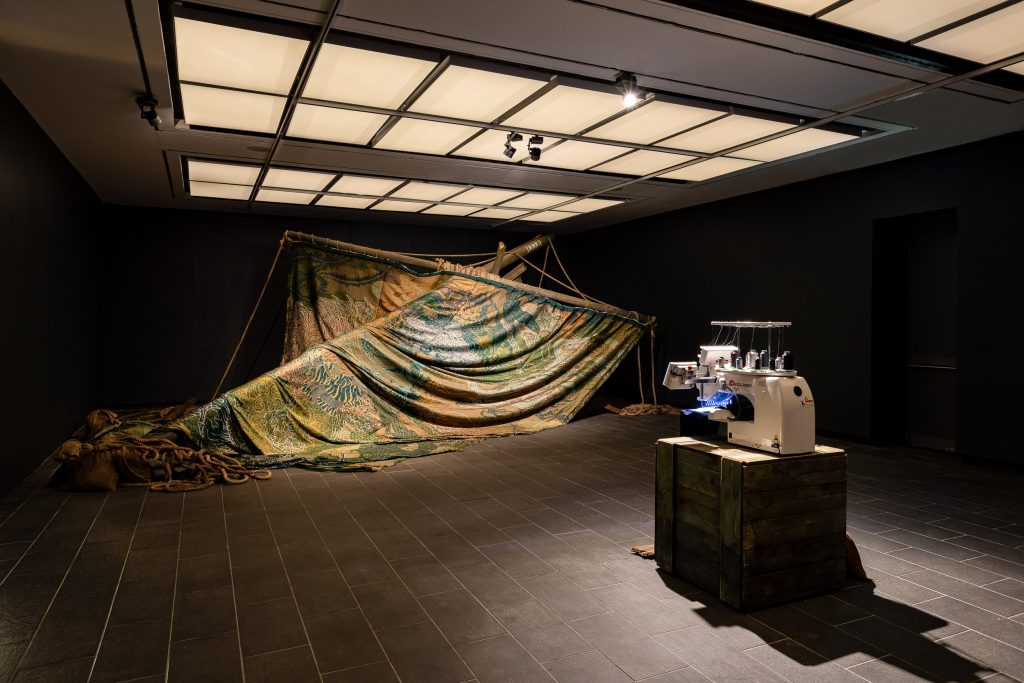
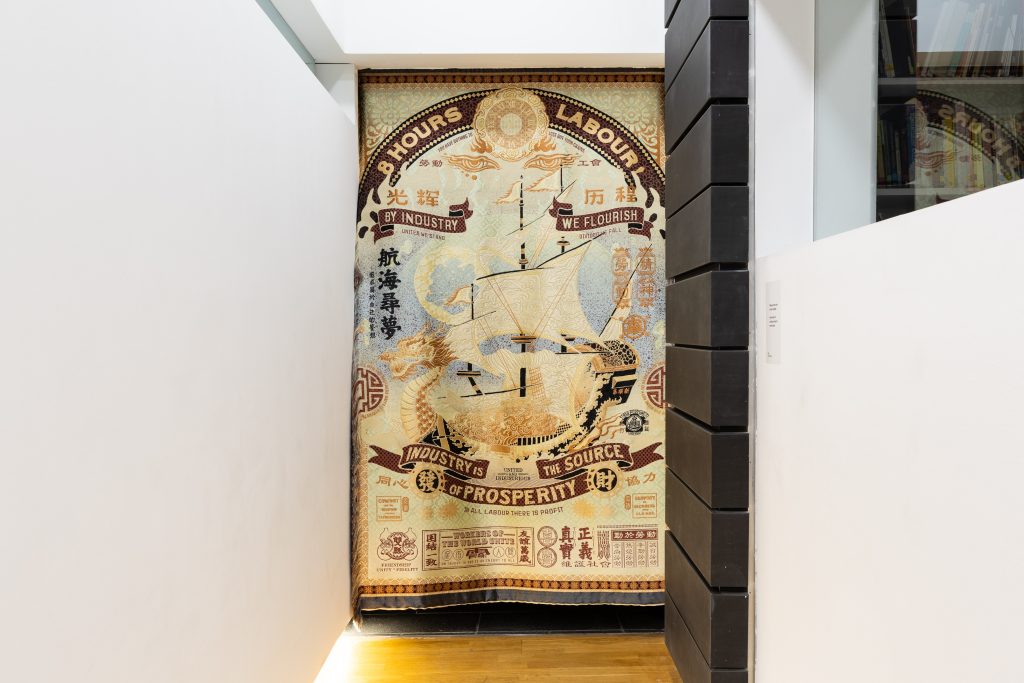
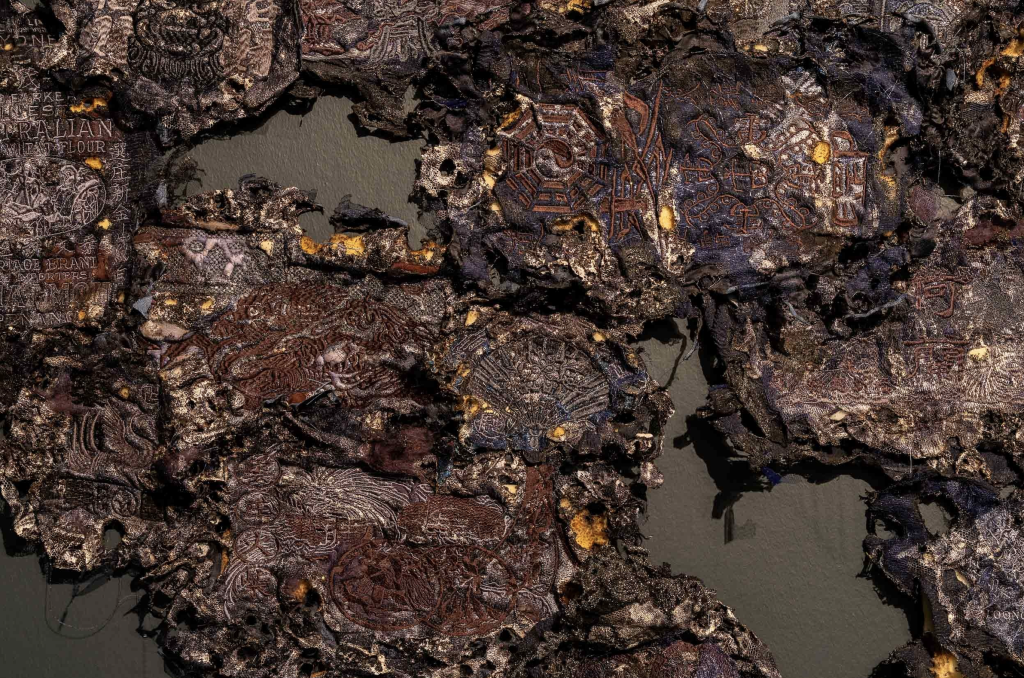
At the centre of the exhibition was a new immersive installation, also titled Smooth Sailing, 一路順風. Visitors entered through a woven poster that reworked trade union certificates from Manchester’s People’s History Museum — documents produced under dangerous conditions, yet charged with hope, solidarity, and belief. Inside the darkened gallery, a broken mast and sail lay run aground, while an embroidery machine continued working, steadily and without pause. Elsewhere, deadstock fabrics were embroidered with blessings, Chinese talismans, and old business logos, bringing together superstition, labour, and everyday economic survival.
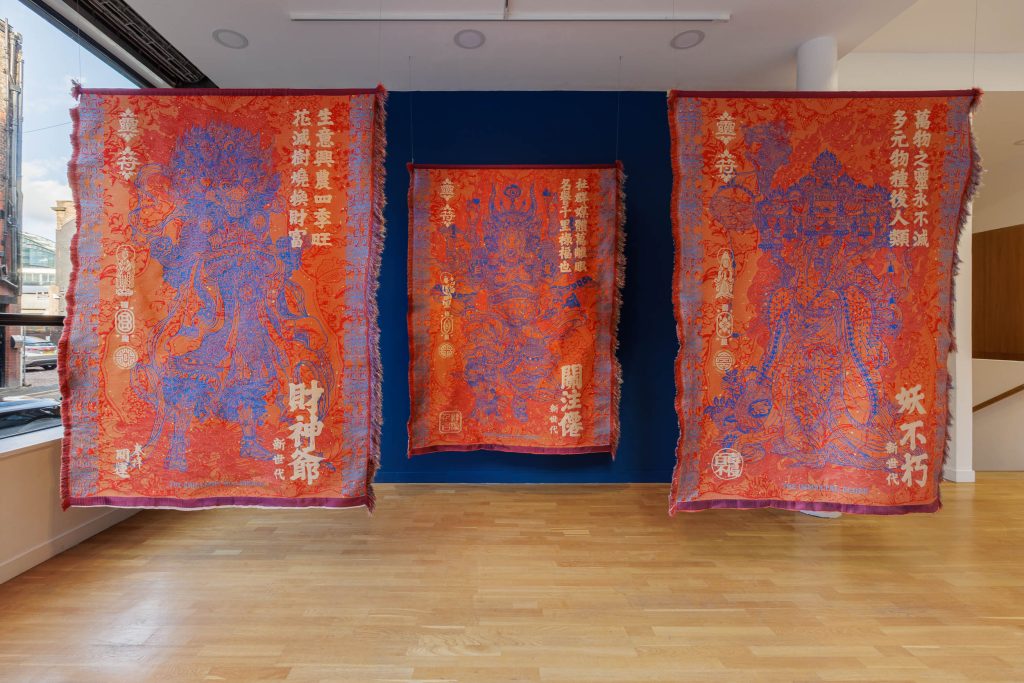
The exhibition also included a new iteration of Three Contemporary Prosperities, which reimagines the Chinese deities Fú (Fortune), Lù (Prosperity), and Shòu (Longevity) as contemporary figures: The Brilliant Billionaire, The Perfect Celebrity, and The Immortal Elder. Encountered at the entrance, the work functioned like an altar — a quiet prompt to reflect on values before moving further into the exhibition. By recasting these figures as contemporary myths, Marcos draws attention to how ideas of fortune and success have shifted, and how we are all, in different ways, implicated in the logics of celebrity, capital, and aspiration.
This moment of reflection sets the tone for the works that follow, which emerge from both the artist’s own migratory experience and broader histories of movement in search of a better future. Across the exhibition, labour continues despite uncertainty: machines run, hands work, materials circulate. Yet the fruits of that labour are fragile, often devalued — rendered surplus or deadstock through market forces beyond the worker’s control. Together, the works sit with this tension between hope and exhaustion, belief and disillusion, and the uneven rewards promised by migration and work.
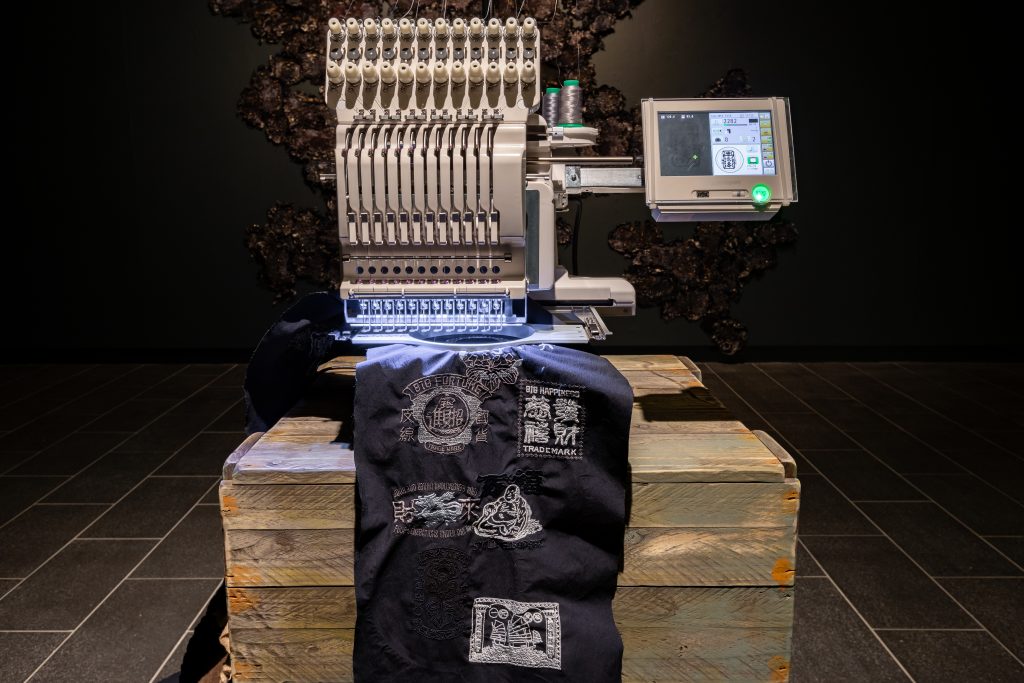
Alongside curating the exhibition, I worked closely with Marcos across research, production, and installation, and helped develop the partnerships that made new commissions possible. Smooth Sailing reflects on journeys, memory, and the afterlives of migration—tracing how textiles hold both the weight of exploitation and the promise of solidarity.
Curator: Jo-Lene Ong
Associate Curator: Julia Jiang
Generously supported by: The Mondriaan Fund, Henry Moore Foundation, Embassy of the Kingdom of the Netherlands, Galerie Ron Mandos, Arts Council England, Greater Manchester Combined Authority
Co-commissioners: Manchester Metropolitan University, Centre for Heritage, Arts and Textile (CHAT), Hong Kong SAR
On from: October 25, 2025 until January 11, 2026 at esea contemporary